dsh-code-reading-coach
在终端中运行以下命令:
dsh plugin install tobysunsun/dsh-code-reading-coach
将以下提示词粘贴到 DeepSeek Harness 对话框中:
在 DeepSeek Harness 中执行 dsh plugin install tobysunsun/dsh-code-reading-coach 安装,来源地址为 https://github.com/tobysunsun/dsh-code-reading-coach,安装后重启 dsh 并在新会话的预设选择器中选择「代码研读教练」。
插件介绍
Reading an AI or systems paper is one thing; making sense of its companion open-source repository is another. Papers follow a predictable structure, but the code behind them varies wildly in language, framework, and layout, leaving most readers staring at a tree of files with no clear entry point. dsh-code-reading-coach is a DeepSeek Harness Agent preset designed for exactly this gap: it walks you through a five-stage method that turns "I have no idea where to start" into "I can narrate the whole system," one small question at a time.
The five stages are: Anchor, where the paper is distilled into three to five core claims that become the questions your code must answer; Terrain, where your familiarity with the language and framework is confirmed before scanning dependencies, directory structure, and test layout; Entry, where a minimal runnable path is identified and the top-level execution flow is traced; Core Mapping, where key modules are read in full and each paper claim is matched to its implementation; and Close the Loop, where you run a minimal test, hand-trace one data path, tweak a single line to observe behavior, and explain it back in a Feynman-style summary. Every stage produces a tangible artifact, and all of them accumulate in a workspace notes.md file so you can pick up where you left off in a later session.
The coach adapts its path to the repository type—training frameworks, kernel libraries, and model repos each get slightly different emphasis—and offers three depth levels (overview, trace, deep-dive) with a Feynman checkpoint before deep-dive to make sure you can actually explain what you just read. When the code contradicts the paper, the discrepancy is flagged explicitly, which is often the most valuable insight. It is well suited to researchers and students working through AI/ML papers, as well as engineers who inherit a bare repository and want a structured, repeatable way to understand it without a formal companion paper.
使用场景
- 读完论文后打开开源仓库,不知从何入手
- 接手陌生代码库,需要快速建立系统性理解
- 逐条验证论文技术主张与代码实现是否一致
适合人员
- 阅读 AI 或系统类论文的研究人员与研究生
- 需要理解开源项目内部实现的工程师
- 希望有结构化引导路径的代码初学者
相关插件
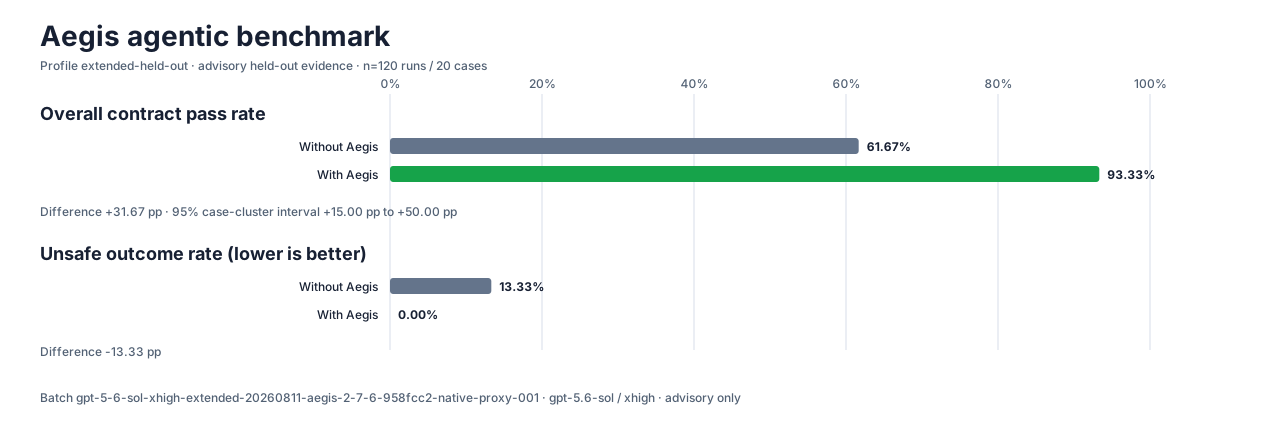
让 AI 编程代理更可信:编辑前对齐真实基线、完成时附验证证据,减少返工与不安全变更。
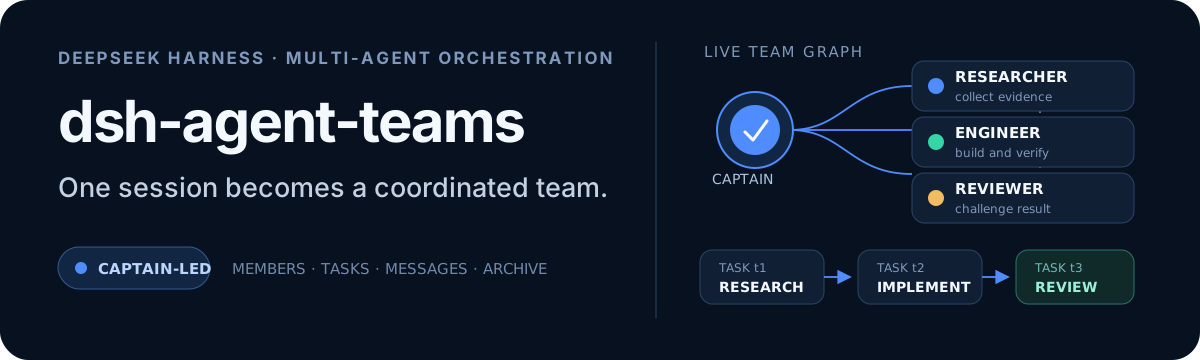
将 DeepSeek Harness 会话变为队长,创建持久子代理团队,将目标拆分为依赖感知任务,并通过直接消息与 Web UI 协调执行。
为编码智能体赋予设计判断力,让 Claude Code、Cursor 等 70+ 智能体直接在终端生成与迭代高质量 UI、演示文稿和图形。
让 Pi 生态的插件无需修改即可运行在 DeepSeek Harness 上,通过实现 Pi 公共扩展 ABI 的兼容层桥接两大生态,并检验 DSH 架构能力。